
Brouwerij Stella Artois - Ab Inbev



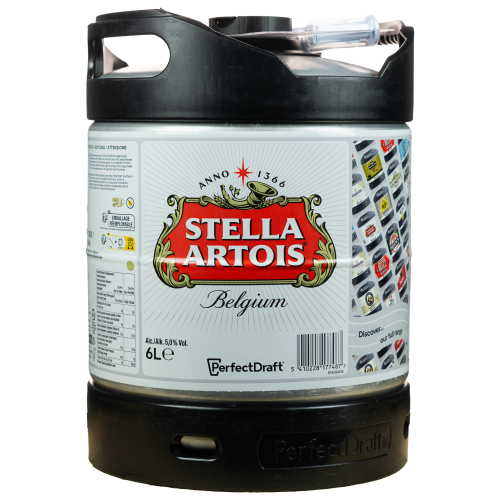

Buy Stella Artois at Belgian Beer Heaven
While light and easy-drinking pilsner was invented in Germany, it is the Belgian pilsners that became world-famous. Stella Artois is no exception. You will find it today in more than 120 countries – and in our webshop. Order your bottles (and the matching beer glasses) or kegs here, and enjoy not only great beer but also these advantages:
- Safe and secure online ordering and payment
- Free collection or fast delivery
- Order before noon, shipped the next working day
- Compact and sturdy packaging
- Shipping includes insurance against glass breakage
Stella Artois, from Leuven brewery to global brand
The history of the Artois Brewery begins on Mechelsestraat in Leuven. In the Middle Ages, the inn-brewery Den Hoorn stood there. At a time when beer was healthier than drinking water, the business thrived. The Stella Artois label still refers to the horn and to the first mention of the inn (although that reference dates from 1466 and not from "anno 1366").
In 1708, Sébastien Artois became master brewer of Den Hoorn and in 1717 he took over the business. Due to the lack of a male heir, the brewery passed to nephews or sons-in-law with different surnames. Nevertheless, the name Artois Brewery was preserved.
From the 1950s onward, Artois acquired several Flemish breweries, including the Meiresonne Brewery in Ghent (in 1964) and the Dommelsche Bierbrouwerij in Dommelen (in 1968). In the 1970s, the company concluded a secret agreement with Piedboeuf Brewery, producer of the pilsner Jupiler, the largest competitor of their own Stella Artois.
A raid by the Special Tax Inspectorate exposed the fraud, resulting in the mandatory merger of Artois and Piedboeuf into Interbrew in 1988. This was followed by acquisitions of the Lootvoet brewery in Overijse and the Grade brewery in Mont-Saint-Guibert, which together marketed Leffe, as well as Belle-Vue in Sint-Pieters-Leeuw. In 2004, the merger between Interbrew and Brazilian AmBev created InBev, which four years later, together with Anheuser-Busch, formed AB InBev.
Stella Artois, the star of the Artois Brewery
Today, when people say Artois, they automatically think of Stella. Artois launched its first pils, Bock, in 1892. But it was not until 1926 that the brewery achieved real success with the introduction of Stella (Latin for “star”). According to legend, Stella was originally intended as a Christmas beer, and its name referred to the Christmas star. Owing to its great success, it was immediately brewed year-round. The brewery also attached its own name to it — a clever marketing strategy to boost brand recognition.
Gradually, the well-selling Stella pushed the other Artois beers out of the range. In the 1960s, it became Belgium’s market leader. Despite the secret agreement with competitor Piedboeuf and its Jupiler, Stella Artois declined in the 1980s. Artois/Interbrew responded by successfully marketing Stella abroad (notably in the UK and Ireland) as a "premium pilsner". In 2020, AB InBev launched the alcohol-free version Stella Artois 0.0.